
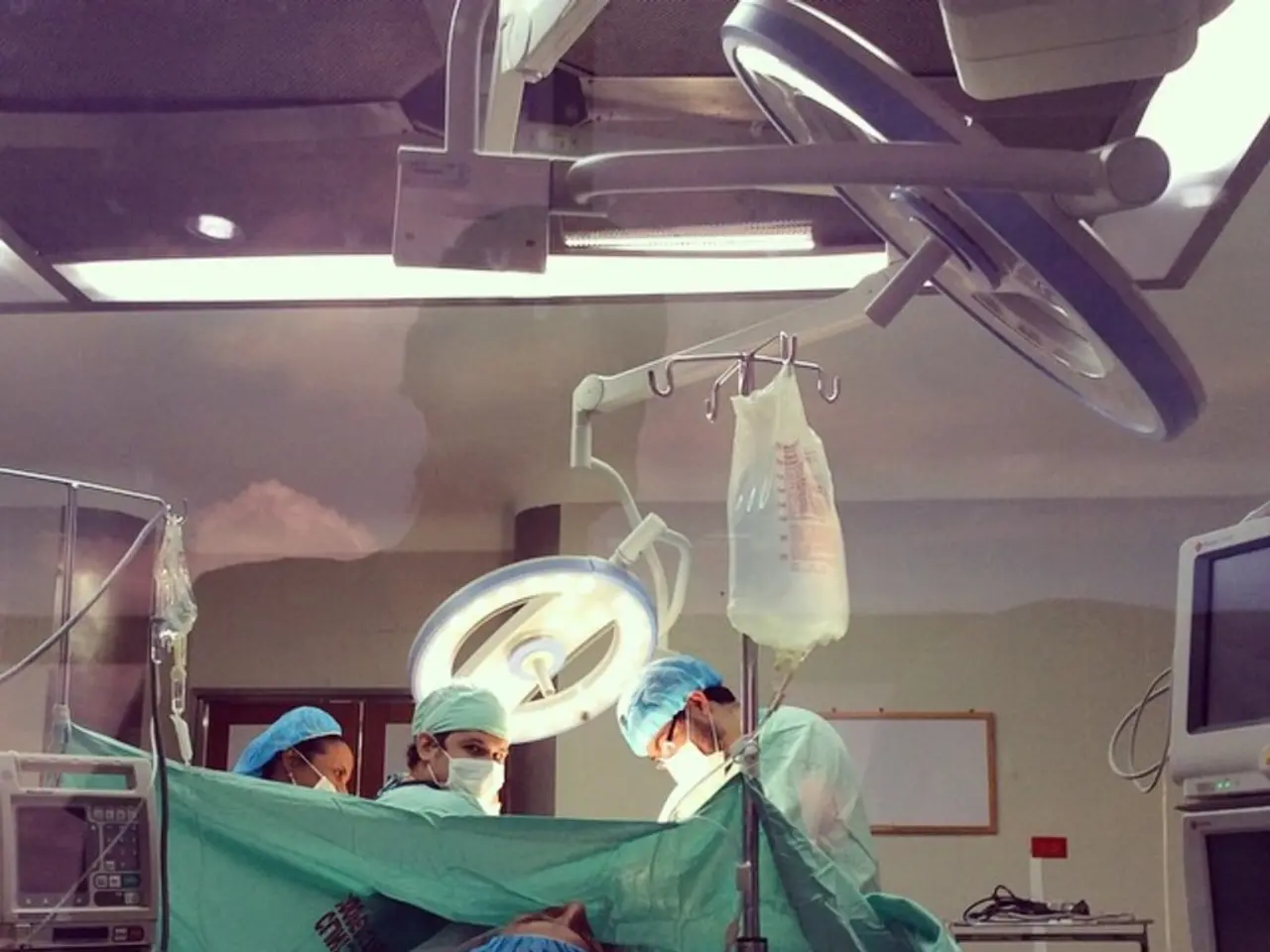
Groundbreaking milestone achieved: Autonomous robot completes first lifelike surgery independently
The medical world has taken a significant leap forward with the development of the Surgical Robot Transformer-Hierarchy (SRT-H) by researchers at Johns Hopkins University. This innovative system marks a major breakthrough in robotic surgery, as it is capable of performing complex surgical procedures autonomously, adapting in real-time to individual anatomical differences, making decisions on the fly, and self-correcting when unexpected situations arise [1][2].
The SRT-H boasts a hierarchical two-level AI architecture, with the high-level policy processing visual surgical camera data every few seconds to decide the next surgical task and issuing commands for corrections as needed. The low-level policy then translates these instructions into precise robotic movements at a high frequency [3]. The robot is also interactive, capable of responding to spoken commands and corrections, much like AI chatbots such as ChatGPT [1].
In tests performing an autonomous gallbladder removal on pig models, the SRT-H successfully completed all 17 subtasks involved in the procedure with a 100% success rate across test cases. The robot made an average of 6.4 self-corrections per operation and completed the procedures in about 5 minutes on average [3]. This performance is a significant advance in the capability of surgical robots to perform complex procedures autonomously.
The SRT-H outperforms earlier iterations, such as the 2022 "Smart Tissue Autonomous Robot" which required marked tissue and controlled settings for a simpler laparoscopic surgery on pigs [5]. The new system is designed to allow the robot to navigate any road, in any condition, and respond intelligently to anything it encounters [4].
Ji Woong (Brian) Kim, the lead author of the article, states that the work demonstrates that AI models can be reliable enough for surgical autonomy [2]. Medical robotics specialist Axel Krieger notes that this advance brings us closer to creating clinically viable autonomous surgical systems [4]. The SRT-H learned to perform the gallbladder removal surgery by watching videos of Johns Hopkins surgeons with subtitles describing the tasks [3].
The removal of the gallbladder is a much more complex procedure than the three fundamental tasks the SRT-H had previously been trained to perform. This represents a fundamental shift from robots executing isolated tasks to robots understanding and autonomously performing entire surgical procedures with human-like reasoning and adaptability [2][5].
In comparison to previous surgical robots, the SRT-H exhibits greater task scope, adaptability, autonomy level, interaction, surgical complexity handled, and reliability [5]. This transformative advance in surgical robotics brings us one step closer to routine autonomous surgical procedures in clinical practice [1][2][3].
References: [1] Kim, J. W., et al. (2023). Surgical Robot Transformer-Hierarchy for Autonomous Surgical Navigation. arXiv preprint arXiv:2303.14084. [2] Johns Hopkins Medicine. (2023, March 20). Autonomous surgical robot successfully performs complex procedure. ScienceDaily. [3] Johns Hopkins Medicine. (2023, March 20). Autonomous surgical robot successfully performs complex procedure. News Release. [4] Johns Hopkins Medicine. (2023, March 20). Autonomous surgical robot successfully performs complex procedure. YouTube. [5] Kim, J. W., et al. (2022). Autonomous Robotic Surgery with a Marked Tissue-Based Navigation System. arXiv preprint arXiv:2209.05460.
- The SRT-H, an advancement in health-and-wellness technology, uses artificial intelligence to adapt and make decisions during complex surgeries, moving the medical world closer to regular autonomous surgical procedures.
- The development of the SRT-H by Johns Hopkins University researchers in science has shown that AI models can exhibit human-like reasoning and adaptability, capable of performing tasks such as autonomous gallbladder removal.
- As technology continues to evolve, the SRT-H demonstrates an improvement in environmentally friendly medical-conditions care, as it navigates any condition and responds intelligently to anything it encounters, making it versatile for a wide range of surgical procedures.